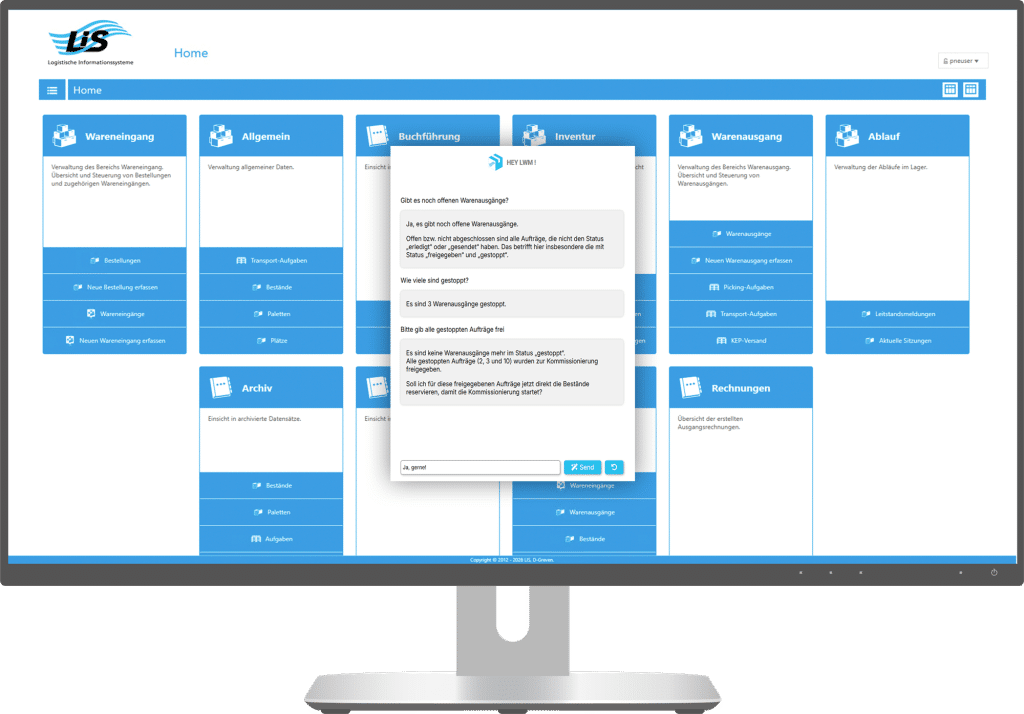
LIS Logistische Informationssysteme GmbH is expanding its LIS Warehouse Management System (LWM) with an AI-powered assistance feature that significantly simplifies access to warehouse data. In the future, users will be able to retrieve inventory information, item movements, order data, and reports directly using natural language, either via text input or voice control. Instead of having to navigate through complex menu structures, users receive context-sensitive answers in real time. This supports faster, more informed, and more reliable decision-making in day-to-day warehouse operations. The new feature will be available starting in the second quarter of 2026.
“Access to warehouse data must be quick and easy in day-to-day operations,” says Philipp Neuser, Head of WMS at LIS. “By integrating AI into LWM, we are significantly lowering this barrier. The AI itself does not need to be trained and can be used in multiple languages. “Employees can use the system like a digital assistant and immediately get the information they need for their work, without lengthy training or in-depth knowledge of the system.”
The new assistance feature directly accesses live data and existing documentation in the system. In addition to standard queries about inventory or orders, you can also perform simple data analyses and generate ad hoc reports. In this way, the AI supports control centers, warehouse management, and operational staff in particular with their day-to-day decision-making. The goal is explicitly not to control processes autonomously or to replace employees, but rather to specifically lighten their workload in their day-to-day work.
Additional benefits are evident during system migrations and when onboarding new employees. “Companies lose a lot of time, especially during the commissioning phase or when there are staff changes, because new users first have to familiarize themselves with the user interfaces and process logic,” explains Neuser. “Voice-based interaction makes it possible to work productively right from the start.” “That’s a real advantage in times of a skilled labor shortage and rising cost pressures.”
The integration of AI fits seamlessly into LIS’s existing product strategy of consistently evolving LWM toward intuitive operation, greater transparency, and faster decision-making processes. “We don’t see AI as an end in itself,” Neuser emphasizes. “It must be used where it solves real problems.” “That’s exactly what this feature does in day-to-day warehouse operations.”